
Alkyd Resins in Coatings: Evaluating 2K PU Crosslinking

Updated: November 2, 2026
Alkyd Resins in Coatings: Evaluating 2K PU Crosslinking
Quick answer: An appropriately designed hydroxyl-functional alkyd can react with a polyisocyanate crosslinker to form urethane linkages in a two-component coating. Conventional air-drying alkyds instead develop their film through solvent evaporation and oxidation of unsaturated fatty-acid groups. Moving to 2K requires verified reactive OH content, compatible components and controlled application conditions; it does not guarantee faster drying or better resistance. Dongsen supplies polyurethane hardeners and polyisocyanate crosslinking raw materials, not alkyd resins or finished paints.
Is a crosslinker change the right response to a slow-drying alkyd?
A coating that stays soft can delay handling, sanding or packing. Yet surface tack, poor through-dry and weak chemical resistance are different problems. Before moving from a familiar 1K alkyd to a 2K formulation, establish which failure matters and whether the resin is designed to participate in the proposed reaction.
For oxidative drying, review resin oil chemistry, the drier package, film thickness, temperature and air access. For a hydroxyl-functional 2K system, also review equivalent balance, mixing and the time between mixing and application. Trapped solvent, an unsuitable substrate preparation or premature testing can obscure either route. The crosslinker is one key formulation variable alongside the resin, solvents, catalysts, additives and cure conditions.
Define the acceptance requirement before choosing a hardener: early handling without marking, hardness development, water exposure, abrasion, or resistance to a named solvent or chemical. A successful change must meet that requirement within the available application window.
Which alkyd resins can enter a 2K polyurethane evaluation?
Alkyds are oil- or fatty-acid-modified polyesters. Long-, medium- and short-oil descriptions help characterize the resin, but oil length is not a substitute for measured hydroxyl value or a statement of isocyanate reactivity. Drying-oil classification describes another variable: the unsaturated groups available for oxidative drying.
Ask the resin supplier whether the exact grade is intended for polyisocyanate crosslinking. Obtain its OH value, the basis of that value, solids content, solvent package, acid value and relevant functionality information. Residual OH groups may provide reaction sites, but their presence alone does not establish a workable network or a compatible coating.
Also separate two meanings of urethane-modified alkyd. A resin modified with isocyanate during manufacture may still be supplied as a 1K air-drying binder. It is not automatically the same as mixing a hydroxyl-functional alkyd with a separate polyisocyanate immediately before application. This article addresses the latter, with solventborne 2K screening as its primary scope. Waterborne alkyds require a separate dispersion and water-reaction assessment.
What changes when NCO reacts with alkyd OH groups?
The ideal alcohol-isocyanate addition is:
R-N=C=O + R'-OH → R-NH-C(=O)-O-R'
This forms a urethane linkage. Multifunctional reactants can connect resin chains, while resin functionality, accessibility of the OH groups and reaction conversion help determine the network. Increasing crosslink density can restrict chain movement, but a harder film can also lose flexibility or fail an adhesion requirement. The resin-crosslinker pair must be evaluated together.
In contrast, oxidative alkyd drying involves oxygen-driven reactions of unsaturated oil/fatty-acid groups while the carrier evaporates. That route depends on air access and the drier chemistry. If a hydroxyl-functional alkyd also contains oxidatively drying groups, the two mechanisms may both contribute; do not assume that adding a polyisocyanate eliminates every oxygen-dependent process.
Published research on hydroxyl-containing hyperbranched alkyds crosslinked with an HDI trimer demonstrates a specific alkyd-polyisocyanate route and reports composition-dependent results. It does not validate ordinary air-drying enamels, aromatic hardeners, or any Dongsen grade in your formulation. For broader chemistry, see Dongsen's isocyanate-polyol reaction guide.
How do 1K oxidative and 2K isocyanate routes compare?
Use this matrix to select the next experiment. The entries describe conditional formulation directions, not measured improvements or a performance ranking.
On a phone, focus or swipe the table to view all columns.
| Decision variable | 1K Oxidatively Drying Alkyd | 2K Isocyanate-Crosslinked Hydroxyl-Functional Alkyd |
|---|---|---|
| Drying / curing mechanism | Carrier evaporation and oxidation of unsaturated fatty-acid groups. | NCO/OH reaction plus carrier evaporation; oxidative reactions may also remain relevant. |
| Drying and handling time | Check driers, air access, temperature and film thickness. | Potential to change handling development; verify touch-dry, dry-hard and actual handling separately. No universal time advantage. |
| Hardness development | Track development as oxidative cure proceeds. | Network formation may change hardness; assess the development curve and flexibility together. |
| Abrasion resistance | Establish the fully conditioned baseline. | Potential network benefit must survive a defined wear test; hardness alone cannot establish abrasion resistance. |
| Water resistance | Check early and later exposure separately. | Measure whitening, blistering and adhesion after exposure; retained hydrophilic species or incomplete cure may limit results. |
| Solvent / chemical resistance | Identify the actual chemical, concentration and exposure. | Crosslinking may reduce swelling, but solvent rubs do not establish broad chemical or corrosion resistance. |
| Pot life | No freshly mixed A/B reaction window; storage skinning is a separate issue. | A finite mixed-use window must cover viscosity, application quality and film performance, not just visible gelation. |
| Formulation complexity | Manage the resin, driers and application conditions. | Add accurate proportioning, mixing, moisture control, usable-life limits and isocyanate exposure controls. |
| Recommended screening tests | Drying stages, hardness over time, adhesion and exposure tests on the current reference. | Use the same endpoints plus compatibility and pot-life testing, with controlled substrate, dry-film thickness and cure history. |
The decision is whether the new system reaches the required balance within your process. If the current 1K route already meets the specification and the line cannot manage mixed-material waste or exposure controls, 2K may add complexity without sufficient value.
How should NCO/OH demand be calculated?
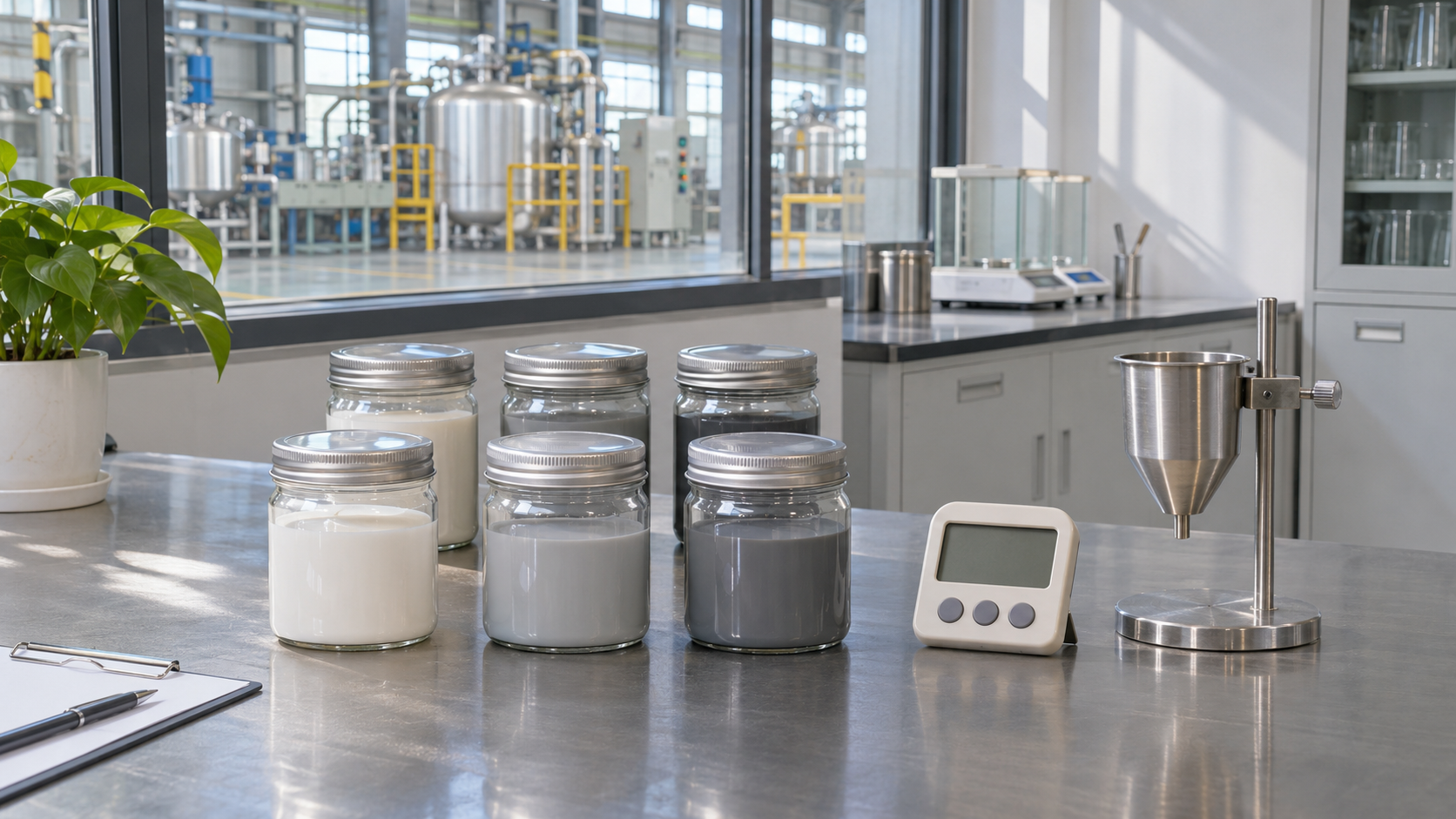
Use reactive equivalents, not a fixed percentage of hardener in paint. The ideal NCO/OH ratio of 1 expresses one NCO group per OH group; it is a stoichiometric reference, not a universal optimum or a 1:1 weight/volume mixing instruction.
Calculation card: keep the measurement bases consistent
Let m be the alkyd solution mass in grams; s its resin-solids mass fraction; H its hydroxyl value in mg KOH/g of resin solids; N the crosslinker NCO mass percentage as supplied; and r the selected NCO/OH equivalent ratio.
OH equivalents = m × s × H / 56,100
NCO equivalent weight = 4,200 / N (g/eq)
Crosslinker mass as supplied = r × OH equivalents × (4,200 / N)
Enter a percentage as its numeric percent value for N, while s is a fraction. If the OH value is already stated per gram of solution, use m × H / 56,100 and do not apply the solids fraction again. If NCO is reported on solids rather than as supplied, resolve that basis before calculation.
The equivalent-weight relationships are documented in USDA research on polyurethane formulation. Only the relationships are used here; its composite formulation and selected index are not an alkyd coating recipe.
For a blend, sum the OH equivalents of each contributing resin or polyol. Identify other active-hydrogen components and moisture separately with the technical team; the simplified OH-only balance is incomplete when those reactions matter. Use current TDS/COA inputs. Increasing the NCO/OH ratio is not a reliable way to correct an unidentified drying defect.
Which crosslinker variables should a buyer compare?
Dongsen's current aromatic range includes TDI-adduct and TDI-trimer hardener types. Those are chemistry directions to discuss after the alkyd's reactivity and solvent system are known. The Aromatic Polyisocyanate category provides a product-discovery route; category membership does not establish compatibility with your alkyd.
Compare supplied solids, NCO content and viscosity on clearly stated bases. NCO content changes the mass needed to deliver equivalents; supplied viscosity affects a different part of formulation work. A lower viscosity at one solids level is not proof of better resin compatibility, faster cure or lower final coating VOC. Compare carrier solvents, mixing behavior and the complete application formulation as well.
TDI-derived aromatic systems carry a yellowing and light-stability boundary. Primary research into polyurethane photochemical weathering describes aromatic-residue oxidation associated with yellowing; it is not a test of this alkyd system. If pale-color retention or outdoor exposure is critical, include the Aliphatic Polyisocyanate direction in the technical discussion and test the complete coating. Changing hardener chemistry does not remove every weathering limitation of the binder.
No exact grade is presented here as validated for a hydroxyl-functional alkyd. Ask for a technically justified shortlist and its evidence limits after supplying the resin and process information. For the broader decision context, see Solventborne 2K.
What should the first screening programme prove?
1. Establish a valid reference and a compatible pair
Record the alkyd identity, OH value and basis, solids, acid value, solvents and supplier guidance. Check candidate mixtures for haze, separation, precipitation and viscosity drift under the intended dilution and mixing sequence. Confirm that solvents, pigments and additives do not introduce uncontrolled moisture or unintended reactive groups. A clear fresh mixture is useful positive evidence; it is not final film-performance evidence.
2. Test application throughout the proposed pot life
Prepare a documented small-batch series using technically agreed NCO/OH levels. Keep a current 1K reference; use a suitable OH-alkyd reference without crosslinker where meaningful. Apply at defined intervals after mixing and record material temperature, ambient temperature, humidity and viscosity. A mixture can still flow while already producing unacceptable leveling or film properties. Do not extend usable life by dilution without a validated procedure.
3. Compare films at matching conditions and ages
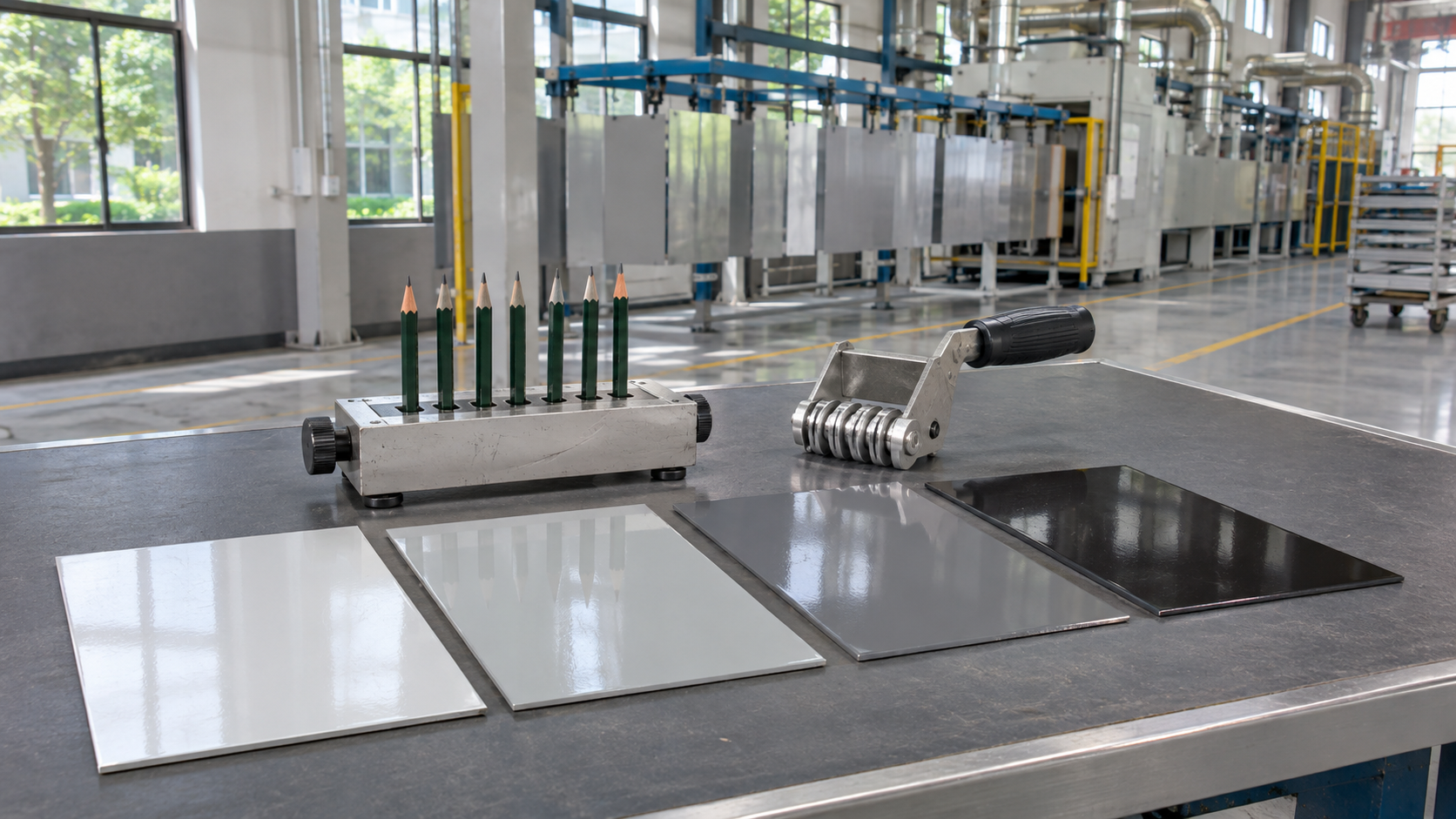
Keep substrate preparation, application method, dry-film thickness and cure history controlled. Record dry-to-touch and dry-hard as separate endpoints, then measure pencil hardness at stated film ages and assess adhesion. Compare water exposure, defined solvent resistance and abrasion using agreed methods and acceptance criteria. Report abrasion equipment, wheel/load/cycles and the measured endpoint; name the solvent and exposure conditions rather than calling a film simply "chemical resistant."
Negative results are decision evidence: haze rejects that blend under the tested conditions; improved hardness with lost adhesion is a failed balance; better early handling with an unusably short application window is a process limitation. Neither a failed blend nor an unrelated successful acrylic case proves the behavior of another alkyd formulation.
Moisture and exposure control are part of the decision
Water competes for isocyanate groups and can generate carbon dioxide through side reactions, disturbing the equivalent balance and contributing to bubbles or other defects. Control raw-material moisture and follow supplier handling guidance; an uncontrolled excess of NCO is not a substitute for moisture control.
Isocyanates can cause occupational asthma and skin effects. Obtain current SDS documents and have a competent person establish handling, ventilation, skin protection and respiratory controls for the actual process before laboratory or application work. The UK HSE provides specific guidance for spraying isocyanate products. This screening discussion is not a safe-use procedure.
What is the next test, and what information is still missing?
Start with a compatibility-and-usable-life screen of a supplier-confirmed hydroxyl-functional alkyd and a technically shortlisted crosslinker. Proceed to controlled panel testing only after that pair remains usable through the required application window. Assess the target film property together with adhesion and flexibility, rather than selecting the highest hardness result alone.
The unresolved variables are the resin's actual OH content and functionality, the solvent/additive package including moisture, and the line's required application and cure window. These determine what should be sampled and what result would count as success. To begin a technical discussion, share those details and the failure you need to resolve.
Buyer takeaways
Confirm the resin before selecting the hardener. Oil length and the phrase "alkyd polyurethane" do not establish reactive OH content. Compare crosslinker inputs on consistent bases, then judge the coating at equal film age and controlled application conditions. A viable 2K route needs a useful balance of performance, working time and exposure control; faster drying alone is an incomplete purchasing specification.
Questions buyers ask before changing cure route
Can I add a polyurethane hardener to any alkyd enamel?
No. First verify the resin's isocyanate-reactive OH content and the full formulation's compatibility. An unidentified finished enamel is not a sound starting point for a universal hardener addition.
Does short oil length prove that an alkyd is suitable for 2K PU?
No. Request the exact resin's OH value, its measurement basis and its intended crosslinking use. Oil length alone does not establish those facts.
Will 2K always dry faster than my current 1K coating?
No. Touch-dry, dry-hard and usable handling can respond differently. Compare them under the intended film thickness and cure conditions while also measuring pot life.
Is a 1:1 NCO/OH ratio a 1:1 mixing ratio?
No. It describes reactive equivalents. The corresponding mass ratio depends on OH content, solids basis and supplied NCO content; volume ratios also require density information.
Can a solvent-rub result establish corrosion resistance?
No. Solvent response and protection of a coated substrate are different endpoints. Specify the exposure, coating stack, substrate preparation and relevant corrosion test separately.
About Dongsen
Dongsen supplies polyisocyanate hardeners and crosslinking raw materials for coating and adhesive formulation. Its aromatic and aliphatic product families provide chemistry directions for technical evaluation. Dongsen does not supply alkyd resins or finished paints; suitability must be established for the customer's resin and process.
About the author — Vicky Zhao
Overseas Technical Support, Dongsen. Vicky works with international coating and adhesive formulators on waterbased and blocked polyisocyanate crosslinker selection, sample screening, and application troubleshooting. Connect on LinkedIn.
Discuss your hydroxyl-functional alkyd system
Share your resin data and application constraints to discuss the appropriate technical documents, a candidate shortlist and possible sample screening. A grade choice requires technical review of the actual system.
- Resin grade, OH value and basis, solids content and available TDS.
- Solvents, catalyst/drier package and relevant moisture information.
- Substrate, application method and target dry-film thickness.
- Mix-to-application time, temperature, humidity and cure conditions.
- Target property, test method and destination market for feasibility review.
For European enquiries, product and market feasibility must be reviewed before any supply commitment.
WhatsApp: +86 15361757135