
Why Do Waterborne Polyisocyanates Turn Hazy or Form Particles After Mixing?

Why Do Waterborne Polyisocyanates Turn Hazy or Form Particles After Mixing?
Updated: October 6, 2026
Quick Answer: Haze or particles after adding a waterborne polyisocyanate can reflect incomplete dispersion, formulation incompatibility, contamination, or changes as the mixed system ages. Diagnose the appearance together with its timing: uniform milkiness, discrete particles, flocs, foam, and gel-like material are different observations. Start with a controlled comparison rather than assuming every cloudy mixture is a defective crosslinker.
Why are haze and particles different diagnostic clues?
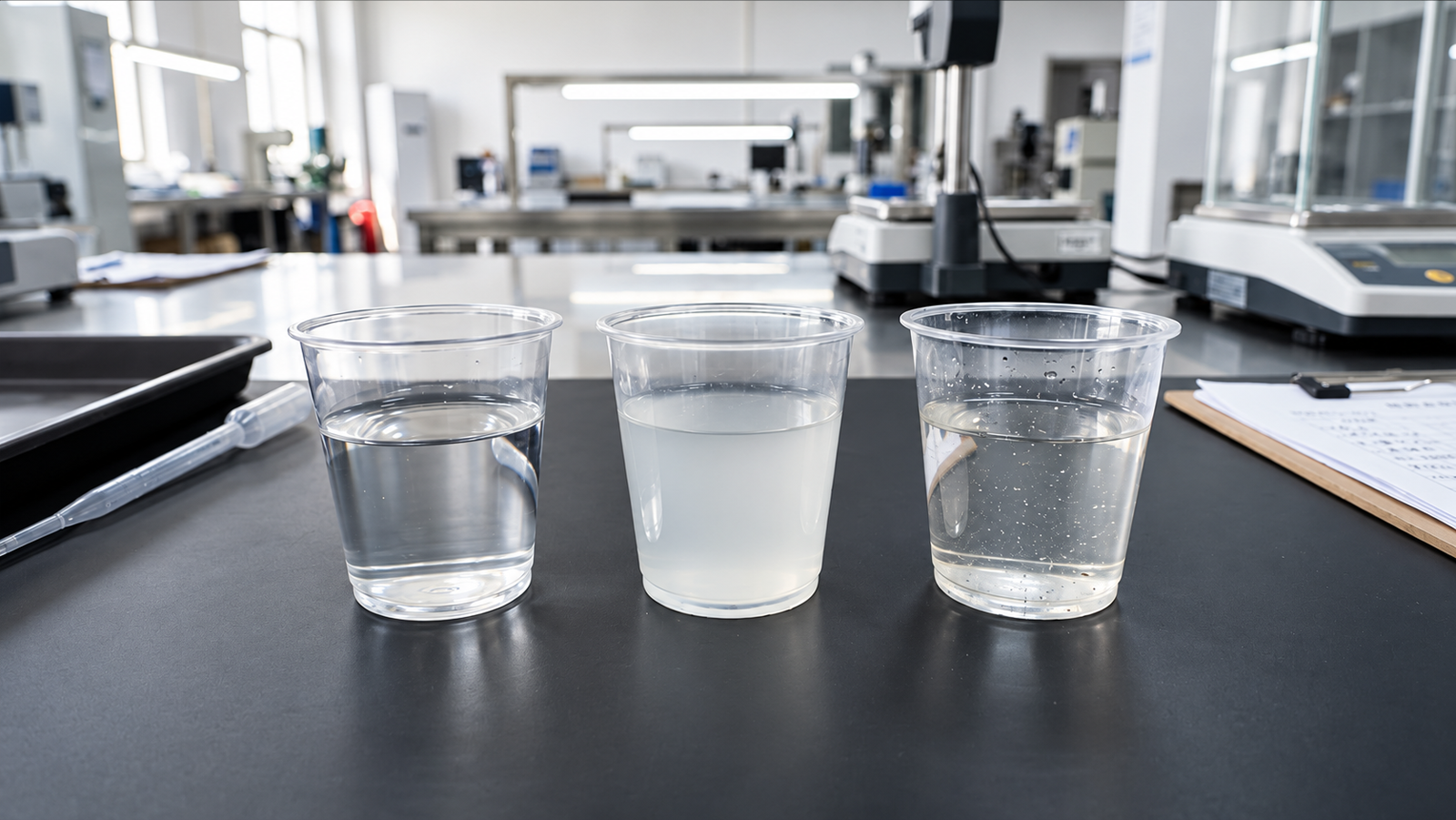
A formulation can turn uniformly cloudy without containing visible lumps. Another may look nearly clear but contain gritty particles. A third may develop soft flocs or a stringy, gel-like fraction. Calling all three "precipitation" loses information that could help identify where the problem begins.
Haze or milkiness describes an optical change. Fine suspended particles are discrete material in the liquid; flocculation describes clusters, often with a loose appearance; and agglomerates are larger collected particles. These descriptions are useful observations, not proof of composition. A photograph cannot establish whether a speck is crosslinker-rich material, binder, pigment, dried residue, or reaction product.
Record whether the change is in the mixing vessel, the wet film, or only the dried coating. Many waterborne binders are already milky before hardener addition, so compare with the binder's normal appearance. Dry-film haze also involves film formation and drying; it should not automatically be diagnosed as a mixing failure.
When does the appearance first change?
Cloudiness at the moment of addition puts initial incorporation near the top of the investigation. Watch the addition point: a concentrated streak that breaks up during mixing is different from persistent flocs distributed throughout the vessel. Compare both with the unmixed binder and hardener.
An initially uniform mixture that changes later needs an aging comparison. Record whether haze, particles, viscosity, or foam develops first, and whether the same progression occurs at the same mixture age in a repeat batch. Immediate incompatibility and time-dependent instability can overlap; timing helps decide which test to run first, rather than proving a cause.
Intermittent particles deserve a batch-history check. Ask whether the defect follows one raw-material lot, an opened container, a particular mixer, or a change in dilution water. Reproducing the symptom in clean small-scale equipment helps separate ingredient-related behavior from a production handling problem.
Which formulation and mixing variables should you investigate?
Does water-dispersible mean compatible with this binder?
Hydrophilic modification helps a polyisocyanate disperse in an aqueous environment; it does not establish compatibility with every PUD, acrylic dispersion, or blend. Binder chemistry and the way particles are stabilized remain relevant. Research on electrostatically stabilized PUDs found that stability depends on polymer structure as well as ionic groups. The finding supports checking the actual binder, not using the word "waterborne" as a compatibility guarantee. See the University of Cologne study of PUD structure and dispersion stability.
A binder-plus-crosslinker screening blend can help locate the problem before the full additive package is investigated. It is a diagnostic comparison, not proof that the same pair will work in the finished formulation.
Could addition order create a local concentration problem?
Keep the total formulation ratio separate from what happens at the addition point. The correct weighed dose can still enter as a concentrated pocket. Compare a documented incorporation method with a controlled addition into the circulating binder, keeping final composition unchanged. Record vessel geometry, impeller position, addition location, and addition duration.
Pre-dilution is a separate variable. Use it only when the crosslinker supplier permits the diluent and procedure. Published polyisocyanate research describes compatible, isocyanate-unreactive solvents as a way to aid incorporation; that is not permission to dilute an unknown hardener with water, alcohol, or any available solvent. If diluent is introduced, account for it in the final composition so an "order" test does not quietly become a co-solvent test.
Is the mixing energy appropriate, rather than simply higher?
Too little effective circulation can leave material poorly incorporated. Increasing mixer speed is not a complete diagnosis: equipment, batch volume, viscosity, mixing time, and temperature also change the result. Some water-dispersible chemistries are designed for relatively gentle incorporation; others require more energy. There is no universal rpm target.
Distinguish persistent particles from entrained air. Record foam, temperature rise, and appearance after a controlled settling period, without exceeding the validated working window. In a specific polyester-based waterborne PU study, higher shear affected isocyanate-water interactions and CO₂ formation. It does not show that high shear damages every waterborne system. See interfacial studies of polyester waterborne polyurethanes.
Were the materials at comparable temperatures?
Record the binder, hardener, dilution water, and mixed-batch temperatures, not just the room temperature. A cold component and a warm component are not the same trial as two conditioned components. Compare mixing and aging within the suppliers' permitted temperature ranges; keep the measurement temperature constant when comparing viscosity.
This separates a temperature-dependent processing change from an ingredient change. It does not establish a universal warming procedure or make heating a remedy for particles. Cold mixing and a coating dried below its film-formation requirements are also different problems.
Could the additive package be changing the dispersion or rheology?
Check the co-solvent package, surfactant or emulsifier environment, and thickener type against the last acceptable formulation. Associative thickeners interact with polymer particles; research on acrylic-PU hybrid emulsions also examined the effect of the surfactant environment. A viscosity change therefore need not be chemical gelation. See the rheological study of associative thickeners in water-based dispersions.
If the binder-plus-hardener blend is uniform but the full formulation is not, compare the relevant additive packages in small controlled batches. For pigmented or filled formulations, inspect the base before crosslinker addition. Pigment or filler agglomerates already present in the base should not be relabeled as crosslinker particles; an unpigmented comparison can be informative, but is not a substitute for validating the complete coating.
Are pH, salts, or water quality relevant to this binder?
For ionically stabilized dispersions, pH and the electrolyte environment belong in the investigation. Their importance depends on the stabilization chemistry. Compare measured pH with the binder supplier's specified range and investigate changed neutralizers, salt-bearing additives, or dilution-water sources. Where water quality is suspect, compare the current source with the formulation's specified water quality at the same dilution level.
Do not assign a universal pH window or assume every particle problem is an anionic-cationic mismatch. Electrostatic stability is only part of the picture, and nonionic stabilization requires a different assessment. Conductivity can help document a water-source change; it does not identify the contaminant or prove the mechanism.
Is the ratio on the correct calculation basis?
Confirm whether the specified addition is based on wet binder mass, binder solids, or reactive equivalents. A percentage copied between these bases can change the actual crosslinker dose. In hydroxyl-functional systems, check the documented NCO/OH calculation with the current material data; PUD identity alone does not establish hydroxyl functionality.
Keep the validated ratio fixed during the first process comparison. A dose series is a separate formulation experiment. Adding more hardener is not a reliable way to rescue a dispersion problem, and no universal optimum ratio can be supplied without the actual binder and crosslinker data.
What does the symptom-and-timing diagnostic matrix suggest?
Use this matrix to choose a first comparison. Each direction is a hypothesis to investigate, not a fault diagnosis or a formulation recipe.
On mobile, scroll the table horizontally to see all five columns.
| What you observe | When it appears | What it may indicate | What to check first | Next controlled test |
|---|---|---|---|---|
| Immediate uniform haze | During incorporation | A dispersion change; it may also be normal for the binder | Unmixed baseline, wet versus dry appearance | Compare binder-only and binder-plus-hardener at matched temperature |
| Immediate fine particles | As hardener enters | Incomplete incorporation or incompatibility | Particle presence in each component; addition method | Repeat the same composition using the documented mixing method |
| Localized particles or larger agglomerates | Near the addition point or vessel wall | Local concentration, weak circulation, or dried residue | Addition location, vessel cleanliness, impeller position | Use clean equipment and change only addition location or rate |
| Loose flocs or separation | Immediately or after standing | A change in colloidal stability | Binder stabilization, changed additive package, pH | Compare a simplified blend with the full formulation; restore one package at a time |
| Initially uniform, then haze or particles | As the mixed batch ages | Time-dependent instability or reaction progression | Mixture age, temperature, formulation history | Repeat at fixed temperature; inspect and apply samples at matched ages |
| Viscosity rise with particles or gel-like material | During aging or mixing | Reaction, rheological association, or coagulation | Actual dose, additives, temperature and unmixed controls | Compare binder-only and mixed-batch aging without changing the ratio |
| Batch-to-batch intermittent particles | Only some batches or containers | Lot variation, conditioning, storage, or contamination | Lot numbers, opened-container history, water and cleaning records | Repeat with retained acceptable lots and clean equipment under the same conditions |
| Bubbles or foam mistaken for haze | During mixing or later | Entrained air; later gas generation is another possibility | Vortex, foam persistence, time of onset | Compare mixing that limits air entrainment at matched temperature and composition |
The useful distinction is whether the symptom follows incorporation, formulation composition, equipment history, or elapsed time. More than one direction may be active. A clearer liquid after extra stirring is encouraging, but it does not establish recovered pot life or acceptable cured-film properties.
How can you test one variable without changing the whole formulation?
Start with an observation you can reproduce. Preserve an unmixed baseline, photograph the mixed material under consistent lighting, and record the first visible change. Use clean small-scale equipment and the same weighed ratio, final solids, and material temperatures as the reference mix.
- Repeat the reference. If the result is intermittent, resolve reproducibility before ranking remedies.
- Choose one contrast. Compare addition method, mixing duration, material temperature, or one additive package. Keep the other recorded conditions fixed.
- Follow the same mixture ages. For a short initial screen, observations at 10, 30, and 60 minutes may help locate onset; these are example checkpoints, not a pot-life specification. Use earlier or longer intervals when the actual process requires them.
- Check the application consequence. Where relevant, compare drawdowns at matched mixture ages and identical film build, substrate, and cure conditions. Give each film the same elapsed cure time before comparing results.
If a simplified blend remains uniform but the complete formula fails, investigate the added formulation packages. If both fail despite controlled incorporation, escalate to binder-crosslinker compatibility screening. Apparent reversibility under stirring is an observation; persistent flocs, recovered viscosity, and film performance still need separate evaluation.
When might the change involve reaction progression?
For unblocked reactive polyisocyanates, NCO groups can react with binder hydroxyl groups. Reaction with water can also consume NCO, release CO₂, and lead to urea formation through subsequent reaction of the resulting amine. These pathways help explain why an aging mixture can change, but appearance alone cannot prove which pathway produced a particle.
Studies of 2K waterborne systems have shown pot-life limitations without a steady viscosity rise, while some showed little particle-size growth during the normal early mixed period. Delayed haze is therefore not automatically "hydrolysis," and lack of thickening is not a reliable clearance test. See the film-formation study of two-component waterborne polyurethane coatings.
Review late changes together with the required application window. The separate 2K waterborne PU pot-life and processing-window guide explains how to assess usable material over time. Fully blocked baking crosslinkers require their own storage and activation assessment; the free-NCO explanation here should not be transferred to them unchanged.
Could storage or contamination explain an intermittent defect?
Inspect the binder and crosslinker separately before repeating the mix. Check sealed versus previously opened stock, storage and conditioning records, and the current TDS/SDS handling requirements. Check the vessel wall, lid, impeller, transfer tools, and cleaning residues for material that could enter the batch.
Use a fresh, traceable sample comparison where permitted. Moisture exposure is relevant to reactive NCO-containing material, but a suspect container history does not prove that every particle arose from moisture. Never return a mixed or contaminated sample to the original container. Keep this investigation separate from a Dongsen-specific batch-quality conclusion until the materials have actually been assessed.
What information should you send your crosslinker supplier?
A short symptom record is more useful than an unexplained request for a "more compatible" hardener. Share enough to reproduce the diagnostic boundary; a complete proprietary recipe is not required for the initial discussion.
- System identity: binder or PUD type, stabilization type if known, crosslinker being evaluated, and whether the system is reactive 2K or blocked baking.
- Composition basis: weighed mix ratio and its basis, solids, relevant co-solvent and additive classes, pigment or filler presence, and pH where relevant.
- Incorporation: addition order, any permitted pre-dilution, mixer and vessel description, mixing time, batch size, and component temperatures.
- Symptom timeline: baseline appearance, onset time, photographs of haze or particles, viscosity trend with method and temperature, foam, and any separation or gel-like material.
- Process target: required working window, application and cure conditions, lot and storage history, and the controlled comparisons already run.
How can Dongsen support waterborne crosslinker screening?
Dongsen is an upstream curing-agent and crosslinker supplier. Its Waterbased Polyisocyanates category is a starting point for discussing water-dispersible crosslinker options. A crosslinker is one formulation variable; binder selection, additives, mixing, application, and cure also affect the outcome.
Dongsen can support screening discussions using the system identity, symptom timeline, and process constraints. Exact-grade suitability requires evaluation in the actual formulation. This guide does not recommend a particular grade, promise universal compatibility, or supply a finished coating, PUD, or resin formulation.
Frequently asked questions
Is a milky mixture always a failed formulation?
A milky mixture is not automatically a failure. Compare it with the binder's normal appearance and the expected wet and dry film behavior; persistent new particles, flocs, separation, or unacceptable film haze need investigation.
Will faster stirring remove every particle?
Faster stirring will not remove every particle or establish compatibility. A controlled mixing comparison can test incorporation, but persistent coagulation, contamination, and reaction-related changes need different checks.
Can I filter the particles out and use the batch?
Filtering visible particles does not prove that the remaining batch is acceptable. It can remove material from the formulation without identifying the cause; confirm composition, process acceptance, and film performance before considering use.
Does waterborne chemistry guarantee compatibility or non-yellowing?
Waterborne describes the formulation medium, not universal compatibility or non-yellowing performance. Assess binder-crosslinker compatibility separately; evaluate color stability from actual chemistry and relevant evidence.
Does an initially clear mix prove that the pot life is satisfactory?
An initially clear or uniform mix does not prove an adequate working window. Observe the mixed formulation and its application performance over the period the process actually needs.
Key takeaways
- Describe haze, particles, flocs, foam, and gel-like material separately.
- Use the time of onset to choose the first controlled comparison.
- Keep formulation ratio and final composition fixed when testing incorporation.
- Confirm the application result; improved liquid appearance alone is not enough.
Discuss your mixing problem with Dongsen
Share your system type, the first visible change, and when it begins. Ask for a bounded screening discussion before changing the full formulation.
- 🔎 Review the binder and crosslinker context.
- 🧪 Discuss a controlled compatibility comparison.
- 📄 Request current TDS/SDS for an agreed candidate.
- 📷 Share symptom photos and the mixing timeline.
Discuss Compatibility Request TDS/SDS Discuss Sample Screening Go to Inquiry Form