
How Humidity Changes Moisture-Cure Speed and the Practical Cure Window
Updated: 2026-10-07
Humidity changes how much moisture is available to an isocyanate-based moisture-curing system, which can change the reaction speed and the time available for application. A practical cure window must also account for temperature, formulation, film or bondline thickness, moisture access and the specific production step being assessed. Dongsen supplies raw-material hardeners and crosslinkers; the finished formulation and its application conditions determine the result.
Why can the same formulation behave differently on another day?
A coating that levels comfortably in one trial may become difficult to work the next time it is applied. An adhesive may feel firm at the exposed edge while the assembly still needs more time before loading. Calling either observation "the cure time" hides the real production question: how long can the material be worked, and when can the next operation begin?
For an isocyanate-based moisture-curing formulation, a change in humidity is one possible explanation. Investigate it alongside material temperature, application thickness and exposure conditions: compare the same formulation and application method, and record how the environment differed.
This guide focuses on moisture-reactive polyurethane systems. It does not set an application range for every moisture-curing chemistry or prescribe a Dongsen grade for a finished coating or adhesive.
What does available moisture change chemically?
In an isocyanate-terminated prepolymer, water reacts with an available NCO group to form an unstable carbamic acid. This intermediate releases carbon dioxide and forms an amine, which can then react with another NCO group to form a urea linkage. Moisture therefore takes part in the reaction; it is not just an environmental reading on the workshop wall.
Research on moisture-curing polyurethane hot-melt adhesives has reported faster reaction as humidity and temperature increased within the conditions studied. That supports a directional explanation, not a universal relationship between RH and time. A published study tests a particular formulation, and its measured conversion is not a cure-time specification for Dongsen raw materials.
Mechanism background: Xing et al., Scientific Reports, DOI 10.1038/s41598-020-78705-4. Humidity and temperature kinetics: Zhou et al., Reaction Chemistry & Engineering, DOI 10.1039/D4RE00385C. These are external technical studies, not Dongsen product tests.
Why does higher humidity not give a predictable cure time?
Reaction rate and moisture transport both matter. Water has to reach the reactive groups, and that access can differ between an exposed coating, a thicker layer and a bondline enclosed between substrates. A surface observation cannot confirm the condition through the full thickness.
The NCO-water reaction also generates carbon dioxide. If that gas is trapped in the developing film or bondline, bubbles or voids may form. Faster surface reaction is therefore not automatically a useful change to the process. Evaluate the surface, the interior and the required performance separately, rather than treating a shorter tack-free time as proof of a better cure.
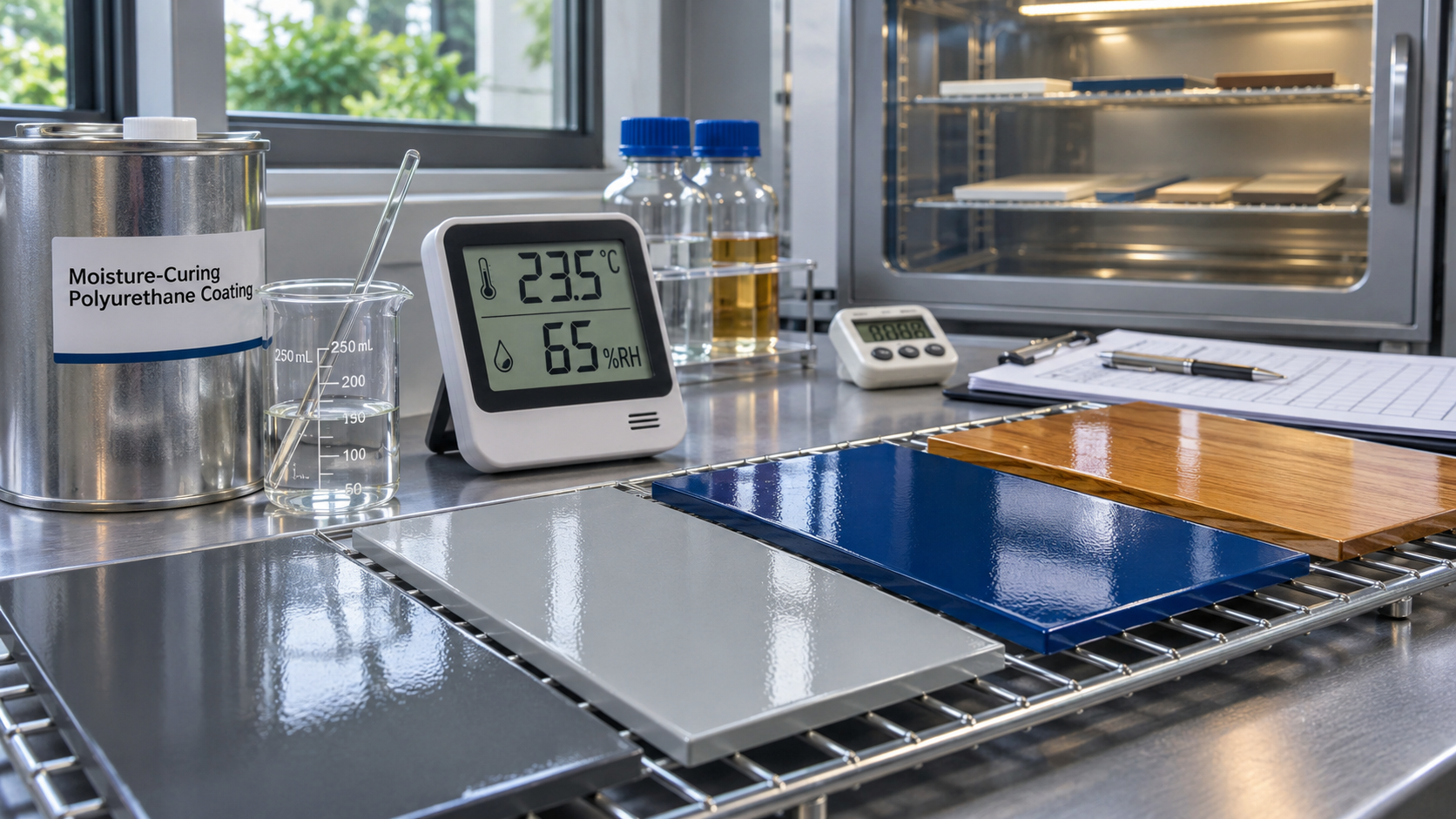
RH itself depends on temperature. The National Weather Service definition of relative humidity explains why an RH reading alone does not describe the actual amount of water vapour in the air. Record temperature alongside humidity rather than comparing isolated percentages taken under different conditions.
There is no humidity-to-hours table here. A usable operating range belongs to the particular material and the tested process. Do not apply a finished-product application range to an entire raw-material family, or assume that higher humidity will always shorten every stage safely.
Which other variables should be kept in the comparison?
Start with the formulation identity and batch. Prepolymer chemistry, available reactive groups, the catalyst package, solvents, fillers and moisture-control components can all alter the response. NCO content, solids and viscosity describe the raw material; they do not establish an exact working time, hardness, adhesion or durability for the finished system.
Film or bondline thickness changes the path that moisture and generated gas must travel. Record wet-film thickness for a coating and bondline geometry for an adhesive. If a comparison changes both thickness and RH, it cannot isolate the effect of humidity.
Substrate condition belongs in the record too: its temperature, preparation, moisture condition and the surfaces that remain exposed. For an enclosed bondline, assess moisture access through the actual assembly; an open test coupon may not represent it.
Airflow and ventilation are another point where a bench trial and a production line can differ. Record the actual arrangement, including transfers between work areas. Do not assume that a fan or an air change is a reliable cure adjustment, and do not reduce required ventilation to retain moisture. Handle isocyanate-containing materials under the current SDS and applicable workplace controls.
What should a practical cure window actually mean?
A practical cure window is a set of demonstrated limits for a named formulation and process: the usable time after exposure, and the readiness point for each operation that follows. It is not a single label attached to an RH value.
For a coating, separate application and levelling from the tack-free check, recoating, sanding, stacking and later service testing. For an adhesive, separate assembly time from handling strength and the strength needed for the intended loading. Choose the stages relevant to the job rather than expecting every test to serve every application.
ASTM D1640/D1640M provides methods for assessing drying, curing or film formation of organic coatings. Select an applicable method and report the endpoint you used. Coating dry-stage observations do not replace an adhesive strength test or establish long-term service performance.
| Observation | Question to separate | Next check before changing the process |
|---|---|---|
| The surface becomes tack-free earlier after humidity changes. | Is the next operation ready? | Check the specific handling, recoat or assembly requirement under the same recorded conditions. Do not release work based on surface touch alone. |
| The material loses workability before application is complete. | Did usable time change? | Repeat the actual application or assembly operation at defined exposure intervals. Record temperature, RH and the point at which the agreed acceptance criterion fails. |
| An exposed coupon performs differently from the assembly. | Does moisture reach the same geometry? | Test the real bondline thickness, substrate arrangement and exposed edges. Keep the open coupon as a comparison rather than treating it as proof for the assembly. |
| The surface looks acceptable, but bubbles or internal voids appear. | Are reaction and gas escape balanced? | Inspect representative thickness and substrate conditions. Compare formulation and exposure changes separately; do not automatically assume the raw material is the cause. |
This matrix separates observations that are often lumped together as "slow" or "fast" cure. Its purpose is to identify the test a decision needs; it does not supply a release time or certify a formulation.

How can a trial produce a usable production window?
Define the acceptance criteria before collecting times. "Dry enough" should refer to a named operation and an observable requirement. Specify what acceptable application, handling or testing means, who assesses it and when the clock starts.
Compare the same formulation under controlled, documented conditions that represent the process, including relevant seasonal variation. Choose conditions within the current material guidance rather than borrowing a generic humidity range from an unrelated product. Keep the application method, thickness and substrate preparation consistent. Where temperature and humidity change together in the plant, record that combined condition rather than labelling the outcome a humidity-only effect.
For each trial, record the formulation and batch identification, exposure start, ambient and material temperatures, RH at the work area, thickness or bondline dimensions, substrate condition, ventilation arrangement, assessment method and endpoint observations. Include defects and any results that fail the acceptance criteria. One successful coupon does not establish a production release rule.
Repeat at representative locations and times, then check the real part or assembly. Report a demonstrated interval for each relevant operation and state the limits of that evidence. A lab observation, a raw-material specification, a formulated-system trial and a production acceptance rule are different records.
What information should you send Dongsen for technical screening?
Dongsen's Moisture Cured Prepolymer category is the family-level starting point for a raw-material enquiry. Category membership does not establish that a particular grade will meet your humidity response or cure-window requirement.
Send the formulation type, substrate and assembly details, application method and thickness, actual temperature and RH records, the operation you need to release, its acceptance criterion and the defect or delay you observed. Include references to the current raw-material TDS and SDS, plus the test method. Share formulation details only through your approved disclosure process.
The remaining questions about moisture access, the usable time your process needs and the endpoint that limits the next operation require project-specific evidence. This article does not recommend an exact Dongsen grade or guarantee a cure result.
If you are evaluating a specific moisture-cure window, share your formulation and process conditions for technical screening.
Questions that change the evaluation
Is tack-free time the same as full cure?
Tack-free time is a surface endpoint. On its own, it does not establish cure through the thickness or readiness for service. Use the endpoint and property tests that the actual operation requires.
Does a one-component system have unlimited working time?
A one-component moisture-curing system can have a limited usable time once exposed to moisture, even though no second component is mixed in. Define when exposure starts and test against the application or assembly acceptance criterion; do not substitute a 2K mixed-pot-life value.
Can higher NCO content identify the faster grade?
NCO content alone cannot identify the fastest acceptable cure in your formulation. Compare candidates only when the formulation, conditions, endpoint and required evidence are explicitly defined.
Can I add water to make cure faster?
Do not add water as an unverified cure adjustment. Water takes part in both the cure reaction and carbon dioxide generation; any deliberate addition requires a formulation-specific, technically approved method and validation.
Can one RH reading define the whole shift?
A single RH reading describes one observation at a particular location and temperature. Record conditions at the work area over the relevant exposure period before using them to explain how a shift behaved.
Key takeaways
- Available moisture can change how the reaction progresses, but formulation and process conditions remain part of the explanation.
- Record usable time and readiness for the next operation as separate endpoints.
- Use representative thickness, substrate geometry and environmental records when translating a trial into a process window.
- Keep raw-material specifications separate from demonstrated formulated-system and final-performance results.
Share your moisture-cure evaluation conditions
Describe the operation that needs a workable window and the conditions in which it must run.
- ✓ Request current TDS and SDS documents
- ✓ Share formulation and process conditions
- ✓ Clarify raw-material screening questions
- ✓ Discuss a project-specific sample evaluation